
Learn about Aijiren Sample Vials Caps&Septa
2022-11-03
Many customers attach importance to sample vials but ignore the choice of caps and septa, which is actually quite important. Better experimental results can be obtained by selecting the appropriate septum. Now I have compiled a set of detailed guides, and let me choose the right caps and septa according to different needs!
PTFE/Silicone
It has the anti-corrosion properties of PTFE and the sealing properties of silica gel and has a wide temperature range of -40℃-200℃
For normal-phase solvents with strong penetration, such as n-hexane, dichloromethane, etc., if the liquid level is too high, it will cause swelling. (PTFE: Teflon, Teflon)

Pre-slit PTFE/Silicone
Use when using a blunt or thin needle for the syringe;
Eliminate the current situation of needle blockage at the bottom end after injection;
Prevents vacuum from forming in vials;
Operating temperature range -40℃ to 200℃.

PTFE/Silicone/PTFE
Recommended for multiple injections;
Autoclavable and autoclavable;
For internal standards, trace analysis or experiments with long injection intervals;
Operating temperature range -40℃ to 200℃;
PTFE/silicone/PTFE septa have the same chemical compatibility as PTFE septa until punctured. We recommend PTFE/silicone/PTFE septa for susceptible samples as the PTFE layer acts as a chemical-resistant barrier.

Pre-bonded cover PTFE/silicone septa
The caps and septa are bonded together using an adhesive-free bonding process. The PTFE layer contact reagent of the composite spacer has good chemical inertness, acid resistance, alkali resistance, temperature resistance, and anti-sticking resistance. At the same time, the elasticity of the silicone rubber can ensure the sealing performance; it can also ensure that the septum does not detach from the cover during transportation. During the puncture process, even if the injection needle is thick and blunt, it can also ensure that the gasket is not poked into the sample bottle.

Butyl rubber stopper
Temperature range -50℃ to 150℃;
Suitable for organic solvents, and acetic acid; good sealing performance can effectively prevent air leakage.

PP septa
Economical, suitable for storing non-corrosive samples, long-term storage of liquids is not recommended, only room temperature storage.

Next News:
Back to List
Laster News
-
 下午6:26Ghost peaks are a materials problem, not a mystery
-
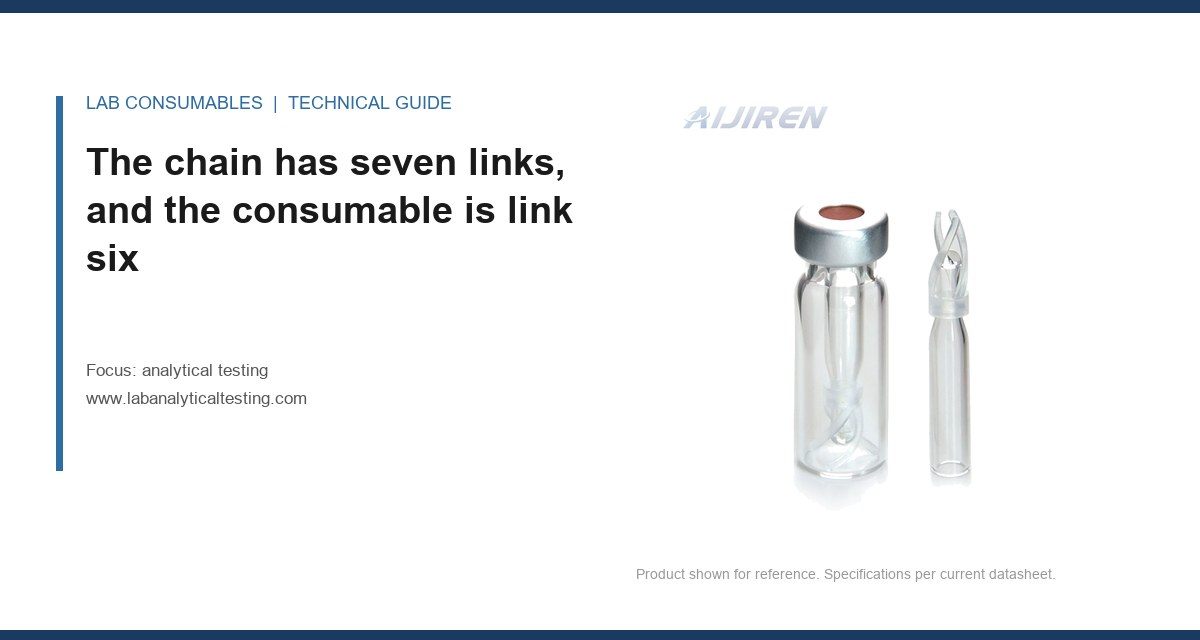 下午6:25The chain has seven links, and the consumable is link six
-
 下午4:34Reorder point is a distribution problem, not a division problem
-
 上午10:33Where the sample actually escapes: the four leak paths that matter
-
 上午10:16SW-846 chapter three is where container and holding-time findings originate
