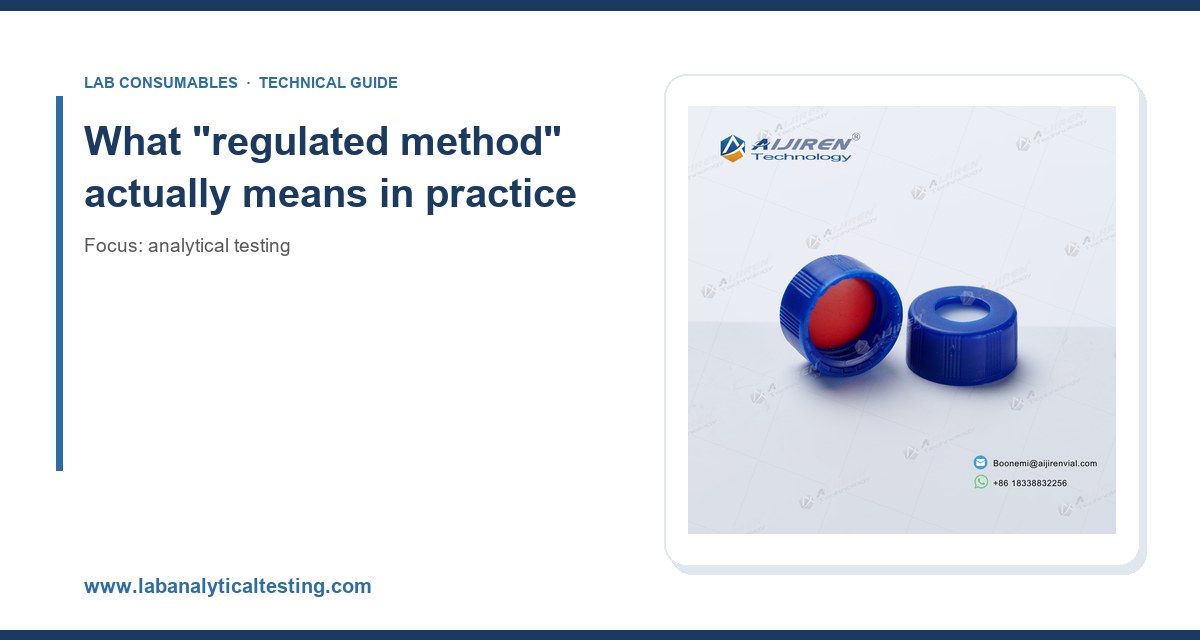
I still remember the day an EPA Method 8260B audit went sideways because of a 2 mL crimp vial. We had a 40 ppb internal standard response failure on a mid-shift run, the kind that looks like a matrix problem until you open the drawer and find the seal batch is 0.008 in thick instead of 0.010 in. That afternoon taught me more about regulated method compliance than three years of SOP writing. Regulatory methods are not just recipes. They are contracts with the agency, and every consumable, column, and calibration step is a clause you can break without noticing.
A regulated method is a written procedure that a regulator has adopted by reference. In US environmental work, that mostly means EPA SW-846 methods for solid waste, EPA 500/600 series for drinking water and wastewater, and EPA TO methods for air. In food and pharma, it means AOAC Official Methods of Analysis, USP chapters, and ISO standards. Each of these bodies treats validation and quality control differently, and that difference matters when you buy a column or a vial.
The core distinction I want procurement managers to understand is this: a method is not the same as a performance standard. EPA Method 8260D tells you to run an initial calibration with a minimum of five concentration levels and a continuing calibration check every 12 hours. ISO 17025 tells you how to prove your lab can do that consistently. AOAC 2007.01 (the QuEChERS pesticide method) tells you the extraction sequence. Your job is to satisfy all three layers at once, and the consumables you select have to survive the strictest of them.
If you need a broader orientation, our team maintains a working reference on analytical testing that covers the crossover between method selection and lab operations.
The three-layer compliance model
- Method layer: the analytical procedure (EPA 8270E, ISO 11843, AOAC 991.07). Defines calibration, QC, and acceptance criteria.
- Accreditation layer: ISO/IEC 17025 or NELAP. Defines how you document, train, and audit the method.
- Data integrity layer: 40 CFR Part 160/EPA QA orders or 21 CFR Part 11 for pharma. Defines how you protect records and raw data.
Most audit findings I have seen land in the third layer, but the root cause is almost always in the first. A failed calibration curve at the low end is often a vial septa problem, not a detector problem.
EPA SW-846: the methods you will actually run
SW-846 is a living document. You should not treat it as a fixed book because EPA updates individual methods independently. The U.S. EPA SW-846 test methods for waste and materials page is the only authoritative source, and I check it monthly. The methods that drive most consumable purchasing are 8260 (VOCs by purge and trap GC-MS), 8270 (SVOCs by GC-MS), 8081 (organochlorine pesticides by GC-ECD), 6020 (metals by ICP-MS), and 7196 (hexavalent chromium by colorimetry).
Method 8260D and the purge-and-trap chain
Method 8260D requires a five-point initial calibration with a relative standard deviation (RSD) of ≤ 20% for most analytes, or a coefficient of determination (r²) of ≥ 0.995 if using a linear fit. The continuing calibration check (CCC) is every 12 hours, with a percent difference of ≤ 20%. Those numbers are tight, and they punish inconsistent sample introduction.
Where I have seen labs lose the CCC is on the sparge vessel and the vial septum. A 40 mL VOC vial with a 20 mm PTFE-faced silicone septum is standard for 8260 because the PTFE faces the sample and resists the methanol/water matrix. If the silicone layer is thinner than 0.060 in, the crimp seal leaks during the 11-minute purge and the internal standard response drifts. I specify 0.125 in PTFE-faced septa for 8260 and accept nothing thinner.
For the vial hardware itself, we source 20 mm crimp-top vials from Chromatography Vial because the dimensional tolerance on the neck is held to ±0.15 mm, which matters when the autosampler gripper is 12 years old.
Method 8270E and injection port hygiene
8270E runs semivolatiles on a 30 m x 0.25 mm x 0.25 µm 5% phenyl methylpolysiloxane column, and the injection port is where the money leaks. I replace inlet liners every 100 to 150 injections for dirty matrices and every 300 injections for clean ones. A deactivated liner with a 4 mm ID and a glass wool plug is the default. If you are seeing tailing on 2,4-dinitrophenol, the liner is the first suspect, not the column.
Column selection for 8270 is not a place to save money. A 30 m x 0.25 mm x 0.25 µm column from a major supplier like Agilent chromatography consumables and columns will hold retention time drift to under 0.05 min across a 12-hour sequence if the inlet is clean. A cheap column will drift twice that, and your CCC will fail on the late-eluting PAHs.
ISO methods: the standards that shape sample handling
ISO methods are more prescriptive about sample handling than EPA methods, and that is where most US labs get surprised. ISO 5667-3 covers water sampling preservation and specifies holding times that are often stricter than EPA. ISO 17025 is the accreditation standard, and it does not tell you how to run a method. It tells you how to prove you can.
ISO 17025 and consumable traceability
Clause 6.5 of ISO/IEC 17025:2017 requires that you evaluate and qualify suppliers, and that you keep records of the consumables that affect result validity. In plain terms, your vial and septa lots need to be traceable to a certificate of analysis. If you buy unqualified vials from an auction site, you cannot close that loop. I have watched labs fail an assessment on this exact point.
ISO 11843 and detection capability
ISO 11843 defines the critical value and minimum detectable value for analytical methods. It is the ISO equivalent of EPA’s method detection limit (MDL) procedure in 40 CFR Part 136 Appendix B. The practical difference is that ISO 11843 is statistically explicit about false positive and false negative rates, typically set at α = 0.05 and β = 0.05. If your lab reports MDLs without documenting those error rates, you are not compliant with the ISO interpretation, even if you are compliant with EPA.
AOAC methods: food and agricultural matrices
AOAC methods are the backbone of food safety labs. AOAC 2007.01 (QuEChERS) is the most-cited extraction method for pesticide residues, and it has a specific consumable list: 50 mL centrifuge tubes with 4 g anhydrous MgSO4 and 1 g NaCl, followed by dispersive SPE with 150 mg MgSO4, 50 mg PSA, and 50 mg C18 per 1 mL extract. Deviating from those masses is a method deviation, and a deviation requires a single-laboratory validation.
The AOAC performance standard for a method is typically a Horwitz ratio (HorRat) of ≤ 2.0 for reproducibility. If your HorRat is 2.5, the method is not performing, and the cause is often inconsistent sorbent quality in the dSPE tubes. I have seen MgSO4 with 4% water content instead of the specified ≤ 1% cause exactly that failure.
USP and pharma crossover
USP <621> Chromatography sets system suitability requirements that overlap with EPA practice: tailing factor ≤ 2.0, resolution ≥ 2.0 between critical pairs, and RSD of replicate injections ≤ 2.0% for five injections. If your lab runs both EPA and USP work, standardizing on the tighter of the two criteria saves you from method-transfer headaches.
Consumables selection: a decision checklist with numbers
This is where I get opinionated. Most labs overbuy on instruments and underbuy on consumables, then wonder why their data drifts. Here is the checklist I use when qualifying a new consumable lot for a regulated method.
Vials and septa
- Vial neck tolerance: ±0.15 mm for 2 mL autosampler vials; ±0.25 mm for 20 mL headspace vials. Anything looser causes gripper failures.
- Septa thickness: 0.010 in (0.25 mm) minimum for GC; 0.125 in PTFE-faced for purge and trap. Thinner septa coring is the number one cause of ghost peaks.
- Puncture count: replace septa after 1 to 3 punctures on a crimp vial, 10 to 20 on a screw-top with a silicone/PTFE sandwich. I have seen labs push 50 punctures and then blame the column.
- GPI thread: 13-425 for 2 mL vials, 24-400 for 40 mL vials. Verify the thread standard on the drawing, not the catalog photo.
- Torque: 8 to 12 in-lb on a 20 mm crimp. Under-torque leaks; over-torque cracks the neck and you get a jagged seal that fails at the CCC.
For HPLC work, the vial geometry matters less than the septum and the cap. We standardize on HPLC vial lots that carry a certificate of analysis with septa durometer readings, because a 45 Shore A silicone septum will core at 10 injections where a 55 Shore A will last 25.
Columns and liners
- Column dimensions: 30 m x 0.25 mm x 0.25 µm for EPA 8270; 60 m x 0.25 mm x 1.4 µm for EPA 8081; 15 m x 0.25 mm x 0.25 µm for fast 8260.
- Temperature rating: 325 °C minimum for 5% phenyl columns used in 8270; 280 °C for 8260. Running above the rating shortens column life by 60%.
- Inlet liner: 4 mm ID, deactivated, with glass wool for dirty matrices; 2 mm ID gooseneck for splitless injections. Replace at 100 to 300 injections.
- Septum purge flow: 3 to 5 mL/min. Zero purge flow is a guaranteed ghost peak generator.
Filters and sample prep
- Syringe filter: 0.22 µm PTFE or nylon for HPLC; 0.45 µm for IC. Nylon adsorbs proteins and some basic analytes, so use PTFE for amines.
- Centrifuge tubes: 50 mL polypropylene with a 12,000 x g rating for QuEChERS. Cheap tubes deform at 8,000 x g and you lose the pellet.
- Solid-phase extraction cartridges: match sorbent mass to sample volume. 500 mg / 6 mL is the workhorse; do not downsize below 200 mg for water samples with trace analytes.
When I need a second opinion on consumable chemistry, I call the application team at Aijiren, because they publish actual lot-to-lot data rather than marketing claims. That matters when you are writing a supplier qualification into your ISO 17025 quality manual.
Operational precautions that keep methods in control
Regulated methods fail in predictable ways. These are the controls I insist on in every lab I have run.
Calibration and QC
Run the initial calibration at the start of every method campaign, not once a quarter. Run the continuing calibration check at the interval the method specifies (12 hours for 8260, 12 hours for 8270, 24 hours for many AOAC methods). Keep the calibration standards in amber vials with PTFE-lined caps and replace them at the method-specified expiration, typically 30 to 90 days for volatile mixes and up to 6 months for semivolatile mixes stored at -10 °C.
Sample preservation and holding times
EPA 5030/8260 requires pH < 2 with HCl and storage at 4 °C, with a 14-day holding time for preserved samples. AOAC pesticide methods often require frozen storage at -20 °C and a 30-day hold. If your lab runs both, you need two storage regimes and two labeling schemes. Mixing them is the fastest way to a data invalidation.
Data integrity
Under 21 CFR Part 11, electronic records need audit trails, and under EPA QA orders, raw data must be retained for the period the contract specifies, often 5 to 10 years. If your chromatography data system does not timestamp every integration change, you have a finding waiting to happen.
Troubleshooting checklist
When a regulated method starts failing QC, work through this list in order. I have never needed to go past step six.
- Step 1: Check the septa and caps. Look for coring, tears, or a loose crimp. Replace the lot and rerun the CCC.
- Step 2: Check the inlet liner and O-ring. A dirty liner causes tailing on early-eluting analytes. Replace and rerun.
- Step 3: Check the column. Cut 10 cm off the inlet, reinstall, and condition at the method’s maximum temperature for 30 minutes.
- Step 4: Check the carrier gas. Verify 99.999% purity and replace the scrubber if the moisture indicator has changed color.
- Step 5: Check the calibration standards. Confirm the expiration date and the storage temperature. A standard stored at room temperature for a week is a suspect.
- Step 6: Check the detector. For MS, run the tune check and compare the ion ratios to the method criteria (typically within ±20% of the reference spectrum).
- Step 7: Check the autosampler. Verify injection volume reproducibility by weighing 10 consecutive water injections. A >2% RSD means the syringe or the loop is worn.
If you want a deeper technical reference on column and consumable behavior, the Restek technical resources for chromatography library is the one I recommend to new analysts, and the Thermo Fisher chromatography and sample handling documentation is useful for method-transfer work.
Recommendation: standardize on a qualified consumable list
If I were setting up a regulated lab tomorrow, I would build a qualified consumable list and lock it into the quality manual. That means one vial part number per application, one septum durometer per method, and one column dimension per method class. I would specify the dimensional tolerances in the purchase order, require a certificate of analysis with every lot, and re-qualify any supplier change through a single-laboratory validation. I would also set replacement intervals in the SOP: septa at 3 punctures for crimp vials, liners at 150 injections, columns at 1,000 injections or when the resolution drops below 1.5. Those numbers are not arbitrary. They come from the method acceptance criteria and from the failure modes I have watched cost labs weeks of rework.
Compliance in regulated analytical methods is not a documentation exercise. It is a consumables discipline. The methods tell you what the data must look like. The vials, septa, liners, and columns determine whether you get there. Get the hardware right and the paperwork follows.
References & further reading
Related resources from our lab consumables network:
- Analytical Testing at labanalyticaltesting.com
- Aijiren at aijirentechinc.com
- Chromatography Vial at chromvials.com
- Hplc Vial at hplcvialfactory.com
External references and standards: