I have sat through three different EPA method audits in the last decade, and the one thing that consistently gets a lab into trouble is not bad chemistry. It is a mismatch between the method they claim to be running and the consumables they actually put on the instrument. A method number on a report is a contract. Every vial, septum, column, and standard you use either supports that contract or quietly undermines it. This article is about making the consumables and the method document agree.
A regulated method is a written procedure that a regulatory body (EPA, ISO, AOAC, USP) has validated and that a laboratory is legally or contractually bound to follow. When you report a result under EPA Method 8270E or ISO 17025 accreditation, you are asserting that the sample was prepared and analyzed within the tolerances the method defines. The method defines those tolerances in terms of calibration, quality control, and sometimes the physical hardware.
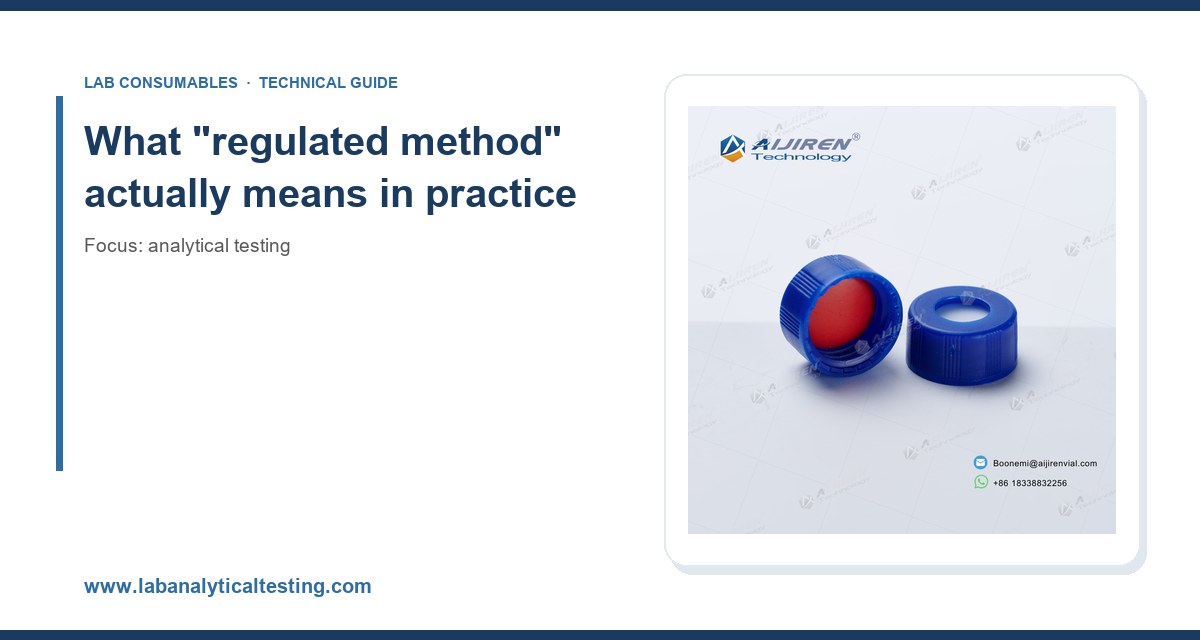
The confusion I see most often is that people treat the method as a chemistry problem and the consumables as a purchasing problem. They are the same problem. If the method calls for a 1.5 mL amber glass autosampler vial with a PTFE-lined silicone septum and the lab buys a 2 mL clear vial with a butyl septum, the method is technically broken before the first injection. That is not a nitpick. Butyl rubber swells in aromatic solvents and leaches plasticizer into the sample, and clear glass lets UV-sensitive analytes degrade on the autosampler tray over a 24-hour run.
For an overview of how these method categories map to routine testing workflows, see analytical testing at labanalyticaltesting.com.
The three method families and how they differ
EPA, ISO, and AOAC methods look similar on paper, but they impose different burdens on the lab. The differences matter when you decide what consumables to stock and how much documentation you need to keep.
EPA methods (SW-846 and the 500/600 series)
EPA methods under SW-846 are prescriptive. They tell you the extraction solvent, the cleanup step, the calibration criteria, and often the exact glassware. Method 8270E for semivolatile organics specifies a 30 m x 0.25 mm x 0.25 µm 5% phenyl-methylpolysiloxane column as a starting point, a calibration range with a relative response factor (RRF) minimum of 0.05 and a %RSD maximum of 15%, and internal standard criteria of 50 to 200% recovery. Those numbers are not suggestions. If your column has been trimmed 1 m past the method’s specification, you have changed the method and you need to document it.
The full SW-846 compendium is the reference document: U.S. EPA SW-846 test methods for waste and materials. I keep a printed copy of the current revision in the lab and check it against the method number on every new project.
ISO methods
ISO methods (for example ISO 17025 for laboratory competence, or analytical methods like ISO 11885 for ICP-OES metals) are less prescriptive on hardware and more prescriptive on the quality management system. ISO 17025 does not tell you which vial to buy. It tells you that you must demonstrate the vial does not contaminate the sample, that you must have a documented supplier evaluation, and that you must be able to trace the lot number of every consumable that touches a reported result.
That last point catches people. If a batch of septa is leaching siloxanes and your QC fails, ISO 17025 requires that you can identify every sample that touched that lot. If your lab does not log septum lot numbers, you cannot do a defensible root cause analysis or a meaningful recall.
AOAC methods
AOAC methods are heavily used in food and agricultural testing, and they lean on collaborative study data. AOAC 2007.01 for pesticide residues in produce, for example, defines the extraction and cleanup in enough detail that the consumable choices are mostly fixed by the method. The consumable risk in AOAC work is different from EPA work: it is less about method deviation and more about cross-contamination between high-concentration standards and low-level sample extracts. That is a vial and septum problem as much as a glassware washing problem.
Where consumables intersect with method compliance
The consumable does not appear in the method text, but it appears in the method’s quality control criteria. Here is where I have seen consumables break a method, in order of frequency.
Septum bleed and the baseline
A silicone septum with a PTFE face is the default for most regulated GC and GC-MS work because the PTFE face is inert and the silicone provides the reseal. The problem is that the silicone is not fully encapsulated, and at inlet temperatures of 250 to 280 °C it off-gasses siloxanes. You see them as a rising baseline and as m/z 73, 147, 207, 281 in the mass spectrum. If your method’s internal standard recovery is drifting low and your blanks are showing siloxane peaks, the septum is the first thing I check.
Puncture count matters here. A septum rated for 50 to 100 punctures at 23-gauge will start to core and leak well before that if the autosampler needle is misaligned or the septum is over-torqued. I have seen labs run a septum for 300 injections to save money and then wonder why the ISTD response dropped 30% over the run. Replace septa on a schedule tied to injection count, not to calendar days.
Vial geometry and autosampler compatibility
The 12 x 32 mm vial is the de facto standard for HPLC and GC autosamplers, and the 9 mm screw thread is the most common closure. But “standard” hides a lot of variation. The GPI 9 mm thread specification defines the thread pitch and diameter, and a vial that is nominally 9 mm but out of GPI tolerance will cross-thread and leak. I have seen a batch of cheap vials that would not seat in a Agilent autosampler tray because the neck OD was 0.2 mm over spec.
For HPLC work, the crimp versus screw versus snap decision is a real trade-off. Crimp vials give the best seal and the lowest evaporation, but they need a crimper that is calibrated and a decapper, and a bad crimp is a leak you cannot see. Screw vials are more forgiving and re-openable. Snap caps are fastest but have the highest evaporation rate on long runs. If your method requires a 24-hour hold time on the autosampler, evaporation is a method compliance issue, not a convenience issue.
Details on the physical specifications are worth reviewing before you standardize: chromatography vial and HPLC vial references cover dimensions, neck finishes, and septum options.
Column selection and the method’s performance criteria
EPA methods often name a column chemistry but allow an equivalent. The trap is that “equivalent” is defined by performance, not by catalog number. If you swap a 30 m x 0.25 mm x 0.25 µm column for a 30 m x 0.25 mm x 0.5 µm column, you have changed the film thickness and therefore the retention and the resolution. The method’s resolution criterion (often R ≥ 1.5 between the critical pair) may still pass, but you must demonstrate it. I have seen labs fail a method audit because they could not show resolution data for the column they actually used.
For GC work, the Restek technical resources are useful for matching column chemistry to method requirements, and Thermo Fisher chromatography and sample handling documentation covers the sample handling side.
A decision checklist for consumable selection under a regulated method
This is the checklist I use when a lab is setting up a new method or switching suppliers. It is deliberately concrete because vague criteria produce vague purchasing decisions.
- Vial volume and geometry: match the autosampler’s specified vial (12 x 32 mm for most; 11 mm or 6 mm for some micro-volume autosamplers). Confirm the neck OD is within ±0.1 mm of the GPI 9 mm specification.
- Glass color: amber for analytes with any UV sensitivity or for methods with a hold time over 12 hours. Clear only when the method and the analyte list justify it.
- Septum material: PTFE-faced silicone for most GC/GC-MS. PTFE/silicone for HPLC. Avoid butyl and natural rubber for any aromatic or halogenated solvent.
- Septum temperature rating: at least 20 °C above the inlet temperature. A 280 °C inlet needs a septum rated to 300 °C or better.
- Puncture count: replace at 50 to 100 punctures for 23-gauge needles, or sooner if the method’s ISTD recovery drifts more than 10%.
- Closure torque: screw caps hand-tight plus a quarter turn, or 0.5 to 0.8 N·m if you use a torque wrench. Over-torque deforms the septum and causes coring.
- Column dimensions: match the method’s specified length, ID, and film thickness, or document the equivalent and demonstrate resolution.
- Lot traceability: log the lot number of every vial and septum lot that touches a reported result. This is an ISO 17025 requirement, not a nicety.
- Supplier qualification: keep a documented evaluation of each consumable supplier, including a certificate of analysis and a sample of the lot.
Operational precautions that prevent most method failures
Most of the method failures I have investigated were preventable with a handful of habits. None of them are expensive.
Calibrate and verify the crimper
A crimper that is out of adjustment produces caps that look sealed but leak. Check the crimp height against the manufacturer’s specification (typically 5.5 to 5.7 mm for a 11 mm crimp) with a caliper on the first ten caps of every batch. A leaky crimp shows up as a low internal standard response and as sample loss on the autosampler tray.
Run a septum blank before the method blank
Before you run the method blank, run a vial of pure solvent with a fresh septum through the full inlet program. If you see siloxane peaks at m/z 73 or 207, the septum is the source. This takes ten minutes and saves a day of troubleshooting.
Control the autosampler tray temperature
If the method specifies a hold time, the tray temperature matters. Most autosamplers hold at 4 to 10 °C, but a tray that is not chilled will let volatile analytes evaporate through a septum over a long run. Check the tray temperature against the method’s requirement, and check the septum’s evaporation rate at that temperature.
Document the consumable in the method file
Write the vial, septum, and column specifications into the method’s standard operating procedure. When the supplier changes, the SOP changes, and the change is reviewed. This is the single habit that has saved me the most audit pain.
Troubleshooting checklist
When a regulated method starts failing QC, work through this list in order. It is ordered by how often the cause is the consumable.
- Internal standard recovery low: check septum puncture count and crimp integrity first, then the inlet liner, then the column.
- Siloxane peaks in blanks: septum bleed. Replace with a higher-temperature-rated septum and re-run the blank.
- Carryover between high and low standards: vial and septum contamination. Check the wash solvent and the septum lot.
- Peak shape degraded: column inlet contamination or a trimmed column. Measure the column length and compare to the method specification.
- Retention time drift: column degradation or a change in carrier gas flow. Check the column against the method’s specified dimensions.
- Autosampler errors: vial neck OD out of tolerance or a misaligned needle. Measure a sample of vials with a caliper.
- QC failure that appears and disappears: lot-to-lot variation in septa or vials. Pull the lot numbers and compare against the failing dates.
Recommendation
For a lab running regulated EPA, ISO, or AOAC methods, standardize on a small, well-documented consumable set and treat it as part of the method. My default for GC-MS work is a 12 x 32 mm amber glass vial with a 9 mm screw thread (GPI 9 mm), a PTFE-faced silicone septum rated to 300 °C, and a 23-gauge needle autosampler. Replace septa at 50 punctures and log the lot number. For HPLC work, the same vial geometry with a PTFE/silicone septum is the safe default, and the closure torque should be 0.5 to 0.8 N·m if you use a torque wrench.
For column selection, match the method’s specified dimensions exactly unless you can demonstrate resolution against the method’s criterion, and keep the demonstration in the method file. For supplier qualification, keep a certificate of analysis and a retention sample for every lot, and evaluate the supplier against the method’s performance criteria, not against price alone. For the broader testing workflow that these consumables support, the analytical testing and Aijiren references cover the method and hardware side in more depth.
Takeaway
A regulated method is a contract that includes the hardware. The vial, septum, and column you choose are part of the method’s performance envelope, and the method’s QC criteria are where that envelope is tested. Standardize on a documented consumable set, replace septa on a puncture-count schedule, log lot numbers, and write the specifications into the SOP. That is the difference between a method that passes an audit and one that passes an audit with a finding you have to explain.
References & further reading
Related resources from our lab consumables network:
- Analytical Testing at labanalyticaltesting.com
- Aijiren at aijirentechinc.com
- Chromatography Vial at chromvials.com
- Hplc Vial at hplcvialfactory.com
External references and standards: