I have sat through three EPA method audits in the last decade, and every one of them came down to the same thing: could I show, on paper and in the chromatogram, that the method as written was the method as run. Not “close enough.” Not “the analyst knows what they’re doing.” The exact injection volume, the exact liner, the exact calibration acceptance criteria from the standard. Regulated analytical work is unforgiving that way, and the gap between a method that passes and one that generates a finding is usually a consumable choice or a documentation habit, not a chemistry problem.
This article is about what changes when a method is regulated: EPA SW-846, ISO 17025, AOAC official methods, USP where it overlaps. I’ll cover how these frameworks actually differ in practice, where consumables and instrument setup interact with compliance, and the specific numbers I use when selecting vials, liners, and columns for regulated work. If you are setting up a method for the first time or fixing one that keeps failing system suitability, this is the checklist I wish someone had handed me.
A regulated method is one where a third party defines the procedure and holds you to it. That is the whole distinction. In a research lab, you optimize until the data looks good. In a regulated lab, you execute a defined procedure within defined tolerances, and you document deviations. The method owns the parameters, not you.
Three frameworks dominate analytical testing in the US and internationally, and they behave differently enough that you need to know which one governs your sample before you touch the autosampler.
EPA SW-846 and the performance-based model
SW-846 is the EPA’s Test Methods for Evaluating Solid Waste, and it governs most RCRA-related environmental testing. The important structural feature is that many SW-846 methods are performance-based rather than prescriptive. Method 8260D for volatile organics, for example, tells you what to achieve (specific analytes, calibration criteria, QC limits) and gives you latitude on how. That latitude is not freedom. It is an obligation to demonstrate your approach meets the performance spec, which means your documentation burden goes up, not down.
Other SW-846 methods are prescriptive. Method 8082A for PCBs specifies column requirements and calibration approach tightly enough that substituting a different phase without a demonstration of equivalency will get you written up. I have watched a lab try to swap a 30 m x 0.32 mm x 0.5 µm column for a 0.25 µm film on 8082A without updating the method documentation. The data were fine. The audit finding was not.
ISO 17025 and the competence layer
ISO/IEC 17025 does not tell you how to run a method. It tells you how to prove your lab is competent to run it. The standard covers method validation, measurement uncertainty, equipment calibration, traceability, and records. When a method is regulated by EPA or AOAC, ISO 17025 is the scaffolding that proves you executed it correctly and can reproduce that execution.
The practical consequence for consumables is traceability. Under 17025, your reference standards need certificates, your balances need calibration records, and your critical consumables should be lot-controlled. A vial is not a reference standard, but if a failed system suitability traceable to a vial lot causes you to invalidate a batch, you need the lot number to investigate. That is why I log vial and septum lot numbers against run dates. It takes thirty seconds and has saved me a full re-run twice.
AOAC official methods and collaborative validation
AOAC methods are validated through multi-lab collaborative studies, which is why they carry weight in food, feed, and agricultural testing. An AOAC official method of analysis has been run by multiple independent labs and the performance statistics (repeatability RSD, reproducibility RSD) are published. That is a different kind of rigor than a single-lab validation. When you adopt an AOAC method, you are adopting a procedure with known inter-lab variance, and your own results should fall within those published limits or you have a problem.
The compliance trap with AOAC is assuming your lab will hit the published reproducibility without matching the method’s sample prep exactly. Grinding, extraction time, solvent ratio, and filtration all matter. A 0.45 µm filter in place of the specified 0.2 µm changes particle load to the column and can shift retention over a long sequence.
Where consumables meet compliance: the vial
Nobody audits your vial choice until it causes a problem. Then it is the first thing the auditor asks about. Here is what actually matters for regulated work.
Glass, dimensions, and the GPI thread standard
Almost all regulated HPLC and GC methods assume a standard autosampler vial. The workhorse is the 2 mL, 12 x 32 mm vial with a 9 mm screw thread or crimp neck. The thread specification you will see on drawings is GPI 9-425 for the 9 mm screw thread, and it is worth knowing because a “9 mm” vial from a supplier that does not hold the thread tolerance will cross-thread or leak. I have had batches of no-name vials where the cap torque that sealed one vial failed the next in the same box. For regulated work, buy from a supplier that publishes the GPI spec and controls glass dimensional tolerance.
Glass grade matters more than people think. Type I borosilicate (USP Type I, ISO 3585) is the standard for pH-sensitive and ionic samples because it resists leaching. Type III soda-lime glass is cheaper and fine for neutral organics at short hold times, but I have seen sodium and calcium leach into aqueous samples held overnight in Type III vials at pH above 8. For regulated methods with long autosampler queues, use Type I. Our own HPLC vial line is specified to Type I borosilicate for exactly this reason.
Septum choice: the number that matters is puncture count
The septum is where regulated methods quietly fail. A standard silicone/PTFE septum is good for roughly 3 to 5 punctures before coring becomes a real risk. A pre-slit septum tolerates more, but the slit lets volatiles escape, which is fatal for headspace GC. For regulated HPLC with a 96-position autosampler running a full sequence, I specify a silicone/PTFE septum rated for at least 10 punctures and I do not re-use vials across sequences. The cost of a fresh vial is cents. The cost of a coring event that plugs the needle and aborts a 12-hour sequence is a day and an investigation.
For headspace GC, use a PTFE-faced butyl or silicone septum with a crimp or magnetic cap, and verify the seal holds pressure. A leaking headspace vial shows up as a low response on the first replicate and normal on the second, which is a confusing pattern that sends people chasing the instrument when the problem is the cap. Torque for a crimp cap should be set so the seal is compressed but the septum is not cut; I check the crimper against a torque gauge every few hundred caps and re-verify the seal by pressure-decay test on a sample of ten.
What I actually stock
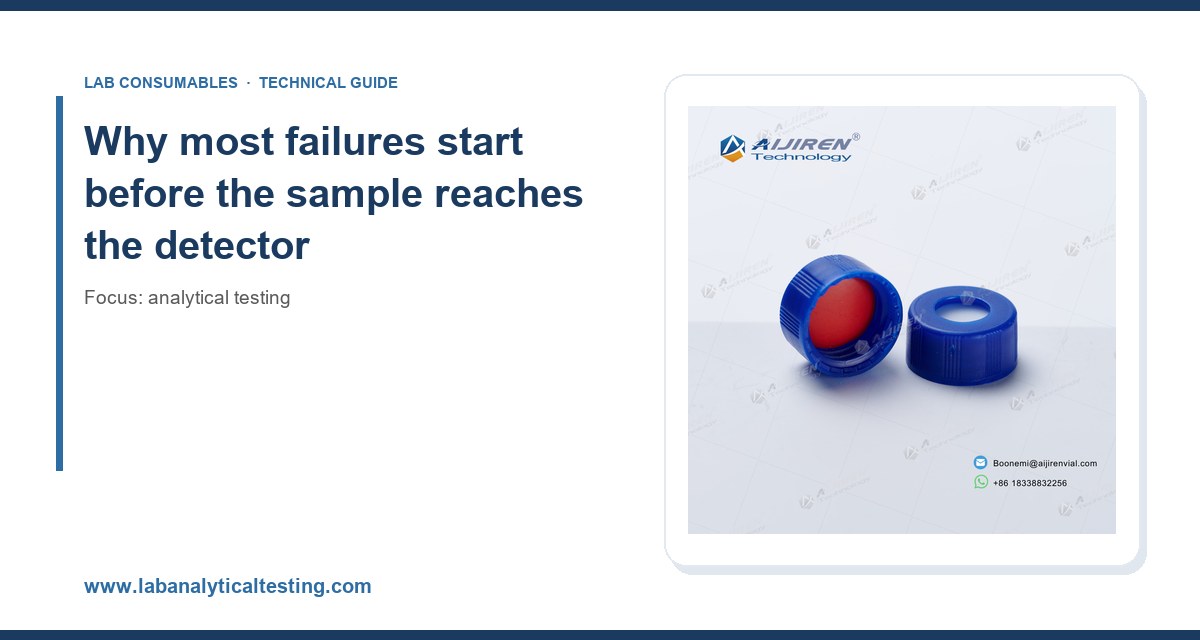
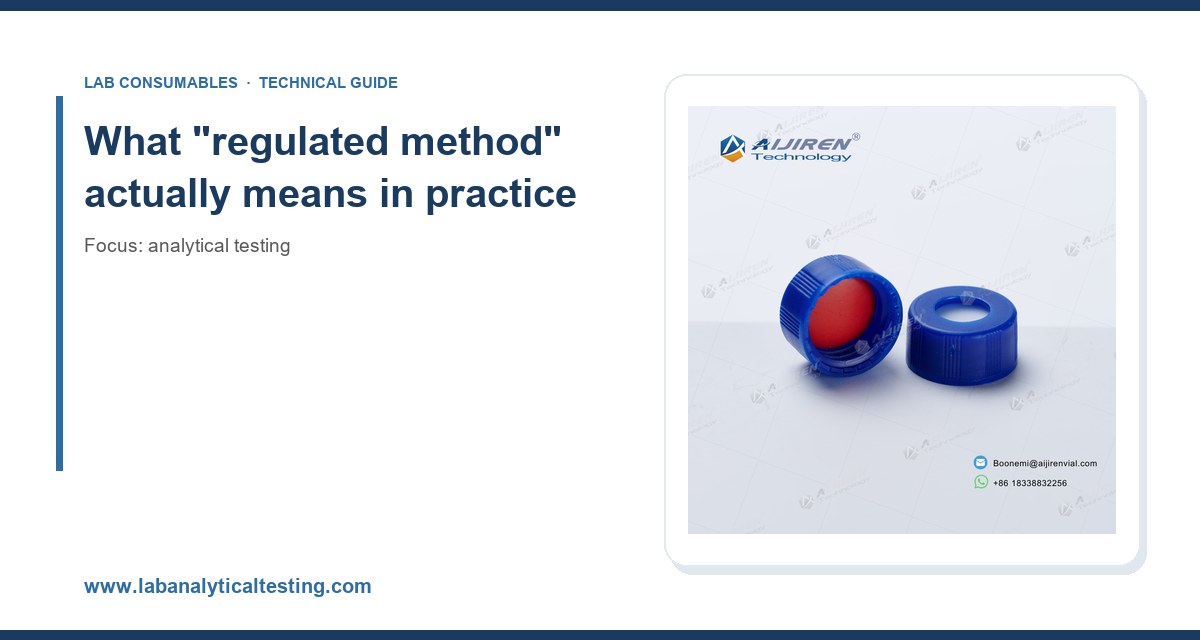
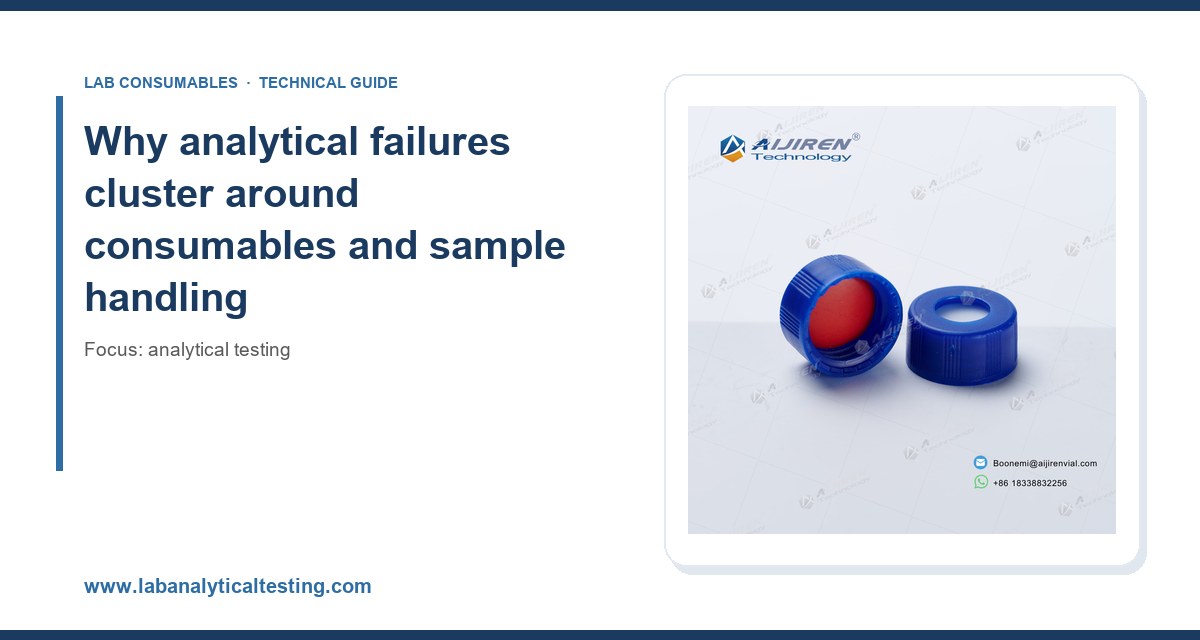
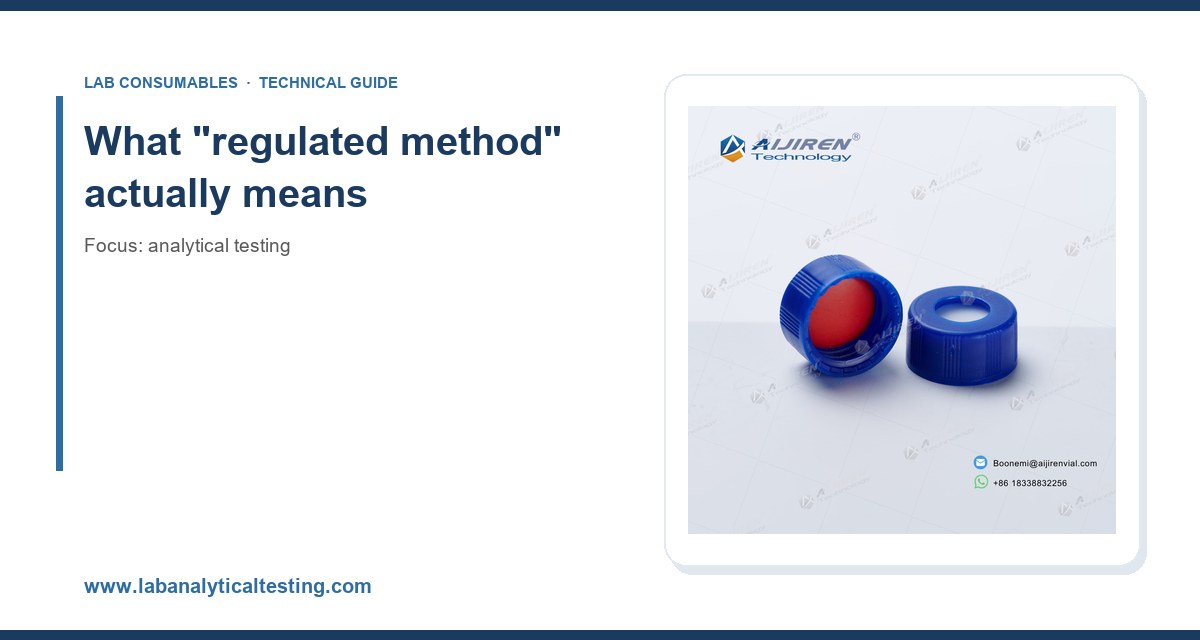
For regulated HPLC work I keep 2 mL clear Type I 12 x 32 mm vials, 9 mm screw thread, with pre-assembled caps and 10-puncture-rated silicone/PTFE septa, plus amber equivalents for light-sensitive analytes. For LC-MS I use a higher-purity grade because the extractables profile matters at low ng/mL. Our chromatography vial selection guide covers the grade differences if you are building a stock list. The point for compliance is consistency: one part number, one lot, logged against runs.
Inlet liners and columns: the parameters the method fixes
Regulated GC methods often specify the liner type or at least the deactivation requirement. Method 8260D, for example, expects a deactivated liner appropriate to the injection technique. If you are running split injection for volatiles, a straight deactivated liner with a small glass wool plug is standard; for direct or on-column injection, a different geometry applies. Swapping liner types without documenting it is a common finding.
Liner deactivation degrades. Silanized liners lose their activity after a few hundred injections, and the symptom is tailing or loss of reactive analytes (phenols, amines, some pesticides). I replace liners on a schedule tied to injection count, not to when the chromatogram looks bad, because by the time it looks bad you have already run non-compliant data. For a busy 8260 method, that is often every 100 to 200 injections. Log the count.
Column selection against the method spec
When a method names a column phase, match the phase, and match the dimensions if the method is prescriptive. For volatile organics by 8260, a 60 m x 0.32 mm x 1.8 µm or 60 m x 0.25 mm x 1.4 µm DB-624-type column is typical. For semivolatiles by 8270, a 30 m x 0.25 mm x 0.25 µm 5% phenyl methylpolysiloxane column is the baseline. If you substitute dimensions, you change resolution and retention, and you owe a demonstration of equivalency under a performance-based method or a method modification under a prescriptive one.
Column bleed and column life interact with compliance because a column near end of life gives you retention drift that fails system suitability intermittently. I track retention time of a mid-sequence standard across runs; a shift of more than 0.05 min on a well-behaved method is a flag to check the column and the inlet. Suppliers like Agilent and Restek publish retention indices and bleed specifications you can use to set your own acceptance windows. Restek’s technical resources in particular are useful for matching a phase to a method without guesswork.
Calibration and QC: the numbers that decide pass or fail
Regulated methods define acceptance criteria, and those criteria are not negotiable. They are the pass/fail line. Here are the ones I work against most often, with the caveat that you always read your specific method version.
- Initial calibration: a minimum of five concentration levels for most SW-846 organics methods, with the low standard at or below the reporting limit. The relative standard deviation (RSD) of response factors across levels should be ≤ 20% for most analytes, ≤ 15% under some methods and for some compound classes. If you exceed it, you may re-fit with a weighted curve or run a second-order fit only where the method allows.
- Continuing calibration: a mid-level standard every 12 hours for many methods, with recovery typically 80 to 120% of the initial calibration response factor. Fail it and you re-calibrate and re-run everything since the last passing check.
- Method blanks: one per batch of up to 20 samples, with target analytes below the reporting limit. A contaminated blank invalidates the batch; find the source (often a vial or a septum lot) before re-running.
- Matrix spikes and duplicates: recovery typically 75 to 125% depending on analyte and matrix, relative percent difference (RPD) for duplicates typically ≤ 20% for water, looser for solids.
- Surrogates: recovery windows method-specific, often 70 to 130% for water samples.
These are the numbers an auditor will check against your raw data. If your LIMS or your spreadsheet does not apply them automatically, you will eventually ship a batch that fails a criterion you did not check by hand. I have seen it happen with a continuing calibration that was 121% on one analyte in a 40-analyte method. One analyte. Whole batch invalidated.
System suitability before the first sample
Before any regulated sequence, run system suitability. For HPLC that usually means replicate injections of a standard and checking retention time RSD ≤ 1%, peak area RSD ≤ 2% for five injections, and a resolution criterion between two specified peaks (often ≥ 1.5 or ≥ 2.0 depending on the method). For GC, similar checks on retention time and response. If system suitability fails, you do not inject samples. Fix the problem first. This is the single most common place where labs cut corners under deadline pressure, and it is the easiest finding for an auditor to spot because the sequence timestamp tells the story.
Instrument setup details that trip audits
Small mechanical details show up in findings more than people expect. A few I have dealt with personally.
Injection volume and precision
The autosampler syringe and its injection volume are part of the method. A 10 µL syringe injecting 1 µL is standard for many HPLC methods; a 100 µL syringe for large-volume injection. If the method specifies 1 µL and you change to 5 µL to improve sensitivity, you have modified the method. Document it or don’t do it. Syringe wear is also a real failure mode: a worn syringe gives injection volume RSD that creeps up. I replace syringes on a schedule and check area RSD at system suitability as the early warning.
Autosampler temperature and sample stability
Many regulated methods specify a maximum autosampler hold time and temperature. A 4 °C tray is common for thermally labile analytes; some methods specify 10 °C or ambient. If your tray chills to 4 °C but your method says ambient, you have a deviation. If your analytes degrade at ambient and the method does not permit chilling, you have a method problem to solve with a shorter queue or a validated hold-time study. Check the tray temperature with a calibrated thermometer, not the instrument readout, at least quarterly.
Carrier gas and plumbing
For GC, carrier gas purity and trap condition affect baseline and detector response. Use ≥ 99.999% helium or hydrogen with an inline gas purifier, and change the purifier on the supplier’s schedule, not on symptoms. A saturated moisture trap shows up as increased column bleed and drifting retention. For regulated work, log purifier installation dates. I have also seen a finding on a leaking septum nut on the inlet; check inlet fittings for leaks with a leak detector at every maintenance, and torque per the manufacturer’s spec (often around 20 to 25 in-lb for the inlet nut on common instruments, but read your manual).
Comparison: choosing a compliance posture for consumables
Here is the decision checklist I use when a lab asks me how tight to run consumable control for a regulated method. The columns are three postures; pick the row that matches your method type.
- Prescriptive method (e.g., 8082A, many AOAC official methods): single supplier, single part number, lot numbers logged, no substitution without a documented equivalency study. Vial: Type I, 12 x 32 mm, 9 mm GPI, 10-puncture septum. Liner: exact type named in method. Column: exact phase and dimensions. Cost of control is high; cost of a finding is higher.
- Performance-based method (e.g., 8260D, 8270E): supplier flexibility allowed, but every consumable change needs a demonstration that performance criteria still pass. Vial: Type I, logged lots, septum rated ≥ 10 punctures. Liner: deactivated, replaced every 100 to 200 injections. Column: equivalent phase permitted with documented performance data.
- ISO 17025 scope with method not externally prescribed: internal control, but traceability and records required. Vial: quality grade, lot logged. Liner and column: internal change control. The standard is your own validation, so document it well.
The pattern is consistent: the more prescriptive the method, the less room you have to substitute, and the more your consumable choice is a compliance decision rather than a purchasing decision. If you are building a regulated consumables program from scratch, our Aijiren manufacturing operation is where I would start the conversation on lot control and dimensional tolerances, because those are the specs that hold up in an audit.
Troubleshooting checklist for regulated runs
When a regulated sequence fails, work through this in order. It is ordered by frequency, not by elegance.
- System suitability failed on area RSD: check syringe for wear, check for air bubbles in the sample loop, check autosampler vial for low fill volume (below the needle depth draws air). Replace syringe and re-run.
- Retention time drift within a sequence: check column temperature stability, check mobile phase degassing, check for a partially clogged inlet frit. For GC, check carrier pressure and inlet septum for leaks.
- Continuing calibration out of range on one or two analytes: check standard stability and storage, check vial septum for volatile loss (especially headspace), check liner deactivation if the analytes are reactive.
- Method blank contamination: trace the source. Swap vial lot, swap septum lot, run a solvent blank through a new vial. Contamination from a septum plasticizer or a cap liner is more common than people admit.
- Peak tailing that appeared suddenly: check liner deactivation and injection count, check column end fittings, check sample pH against column pH range (most silica columns are stable pH 2 to 8; outside that you are dissolving your stationary phase).
- Low response on headspace first replicate: leaking crimp or magnetic cap. Re-crimp with verified torque, pressure-test a sample of ten.
- Resolution below criterion: column near end of life, or mobile phase composition off. Check mobile phase prep against the method, then replace column and re-run system suitability.
For a broader view of how these checks fit into a full analytical program, the resources at analytical testing cover method setup and QC design. And for the instrument side, Thermo Fisher’s chromatography and sample handling documentation is a good reference for matching autosampler and detector setup to method requirements.
Documentation habits that survive an audit
The method is only half of compliance. The other half is the record. Three habits have kept my labs clean.
First, log consumable lots against run dates. Vial lot, septum lot, column serial number, liner lot. When something goes wrong, you can trace it in minutes instead of invalidating weeks of data. Second, record deviations as they happen, with the reason and the corrective action, not reconstructed after the fact. An auditor can tell a contemporaneous note from a retrospective one. Third, keep raw data and processed data together with the method version in force at the time of the run. Methods get revised; a run is judged against the version it was executed under.
None of this is glamorous. All of it is what separates a lab that passes audits from one that spends its time writing responses to findings.
Takeaway
Regulated analytical methods are a contract between your lab and a standard-setting body, and the consumables you choose are part of how you honor it. Match the method’s specified column phase and dimensions or document the equivalency. Use Type I borosilicate 12 x 32 mm vials with 9 mm GPI threads and septa rated for at least 10 punctures, and log the lots. Replace GC liners on an injection-count schedule, not on symptoms. Apply the method’s calibration and QC acceptance criteria automatically, and run system suitability before every regulated sequence. If you do those things, the audit becomes a review of records you already keep, which is exactly what it should be.
References & further reading
Related resources from our lab consumables network:
- Analytical Testing at labanalyticaltesting.com
- Aijiren at aijirentechinc.com
- Chromatography Vial at chromvials.com
- Hplc Vial at hplcvialfactory.com
External references and standards: