The auditor pulled one thing out of the file before she looked at a single chromatogram: the cooler receipt. Twelve samples, 4 °C on arrival, 4 °C at login, and 11 °C at the time the analyst pulled them for extraction the next morning, logged by the lab’s own refrigerator monitoring system. The method said 4 °C ± 2 °C. The data package was clean. The container log was not, and that single excursion cost the lab a 40-hour re-sampling round and a corrective action plan under EPA SW-846. That is the shape of most EPA method findings I have sat through: not a bad column, not a bad calibration, a paperwork trail that does not line up with the physical reality of the sample.
What auditors actually check when they walk into a lab running EPA methods is narrower than the method documents suggest and more specific than most lab managers prepare for. The expectations split cleanly into two halves: what the method text mandates about containers and handling, and what the auditor asks to see first when they open the file. This article covers both, with the numbers and the failure modes I have watched go wrong.
SW-846 is not a single method. It is a compendium, and the part that governs sample containers and handling is Chapter Three, “Inorganic Analytes,” and Chapter Four, “Organic Analytes,” plus the individual method write-ups (3000-series for inorganics, 3500/8000-series for organics). Auditors do not read the whole compendium. They read the method that the lab’s SOP cites, then cross-check the SOP against the method’s container and holding-time table. The three places I see labs drift:
- Container material. Method 3510 and its siblings specify amber glass for extractable organics. Method 3010/3020 for metals allows plastic or glass, but the plastic must be verified free of the analyte of interest. If the lab’s SOP says “glass or HDPE” without a per-analyte restriction, an auditor will ask which analytes were validated in HDPE and where the supporting data lives.
- Headspace. Volatile organics under Method 5030/5035 require zero headspace in the field vial, capped with a PTFE-lined septum and crimped. The auditor asks the field technician, not the lab, how the vial was filled. If the answer is “to the shoulder” instead of “to overflow,” that is a finding.
- Holding time. 14 days from collection for most extractable organics to extraction, 40 days from extraction to analysis; 28 days for metals; 7 days for mercury; 14 days for most volatiles from collection to analysis. The auditor subtracts dates. If collection is 3 March and extraction is 18 March, the sample is 15 days old against a 14-day clock, and the entire batch is qualified.
None of this is obscure. What makes it a recurring finding is that the container and the holding-time clock are decided in the field, by a technician who is not the analyst and may not have read the method. The lab inherits the problem at login.
What the auditor asks for first, in order
I have been on both sides of this table, and the order is remarkably consistent across EPA regions and third-party auditors. The first four items, before any data review:
- The chain-of-custody form, signed at every transfer, with the cooler temperature recorded at receipt. Not a range. A number.
- The container receipt log, cross-referenced to the COC, showing container type, lot number (yes, the lot number of the vials and the septum), and condition on arrival.
- The refrigerator and freezer temperature records for the storage window between receipt and extraction. Continuous monitoring prints, not a daily manual check.
- The method citation on the SOP, matched to the analyte list and the matrix. If the SOP cites Method 8270 but the analyte list includes a compound not in the method’s target list, the auditor wants the validation data.
Only after these four does the auditor open the data package. The reason is straightforward: if the container and holding-time trail is broken, the analytical data is qualified regardless of how good the chromatography is. The auditor is looking for a reason to qualify the batch, and the paperwork is where the reason usually lives.
The container lot number is not optional
This is the item that surprises lab managers most. If a batch of samples fails on a container-related issue, the auditor wants to know the lot number of the vials and the septa so the lab can trace whether other batches are affected. A lab that cannot produce a container lot number cannot perform the recall. I have watched a lab spend three days reconstructing which lot of 40 mL VOC vials was in use during a two-week window because the receipt log recorded “case of vials” and nothing else. The fix is a one-line field on the receipt form. The cost of not having it is a recall you cannot bound.
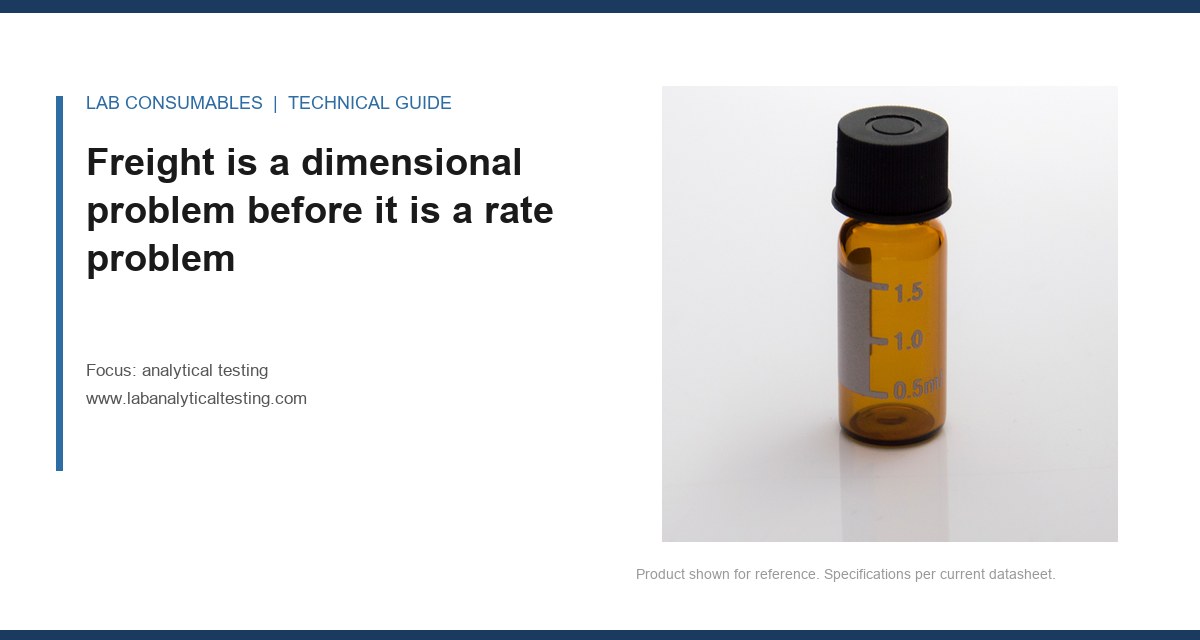
For the physical consumables themselves, the specification matters as much as the lot trace. A 40 mL VOC vial with a 24 mm crimp finish and a 20 mm PTFE-lined silicone septum, crimped to a target of 1.5 to 2.0 inch-pounds of torque (or the equivalent crimp compression the supplier validates), is the working configuration. Under-crimped septa leak; over-crimped septa coring and shed silicone fragments into the sample. The chromatography vial you source should come with a stated septum thickness (typically 0.040 in for VOC work) and a lot-traceable certificate. If the supplier cannot give you the lot, the auditor will eventually ask why.
Container selection is a method decision, not a purchasing decision
The most common structural error I see is a lab standardizing on one container across all methods to simplify purchasing. That works until an auditor asks why the metals samples are in amber glass when the lab’s own SOP says HDPE, or why the semi-volatile extracts are in clear glass when the method specifies amber. The container is part of the method. The table below is the decision checklist I hand to new lab managers.
| Analyte class | Container | Headspace | Preservation | Holding time (collection to extraction/analysis) |
|---|---|---|---|---|
| Volatile organics (5030/5035/8260) | 40 mL amber glass, 24 mm crimp, PTFE-lined septum | Zero (overflow fill) | HCl to pH < 2, 4 °C | 14 days to analysis |
| Extractable organics (3510/8270) | 1 L amber glass, PTFE-lined cap | Minimal | 4 °C, no acid | 14 days to extraction, 40 days to analysis |
| Metals (3010/3020/6010) | 500 mL HDPE or glass, analyte-verified | Not critical | HNO3 to pH < 2, 4 °C | 28 days (180 days for mercury in some matrices; check the method) |
| Mercury (7470/7471) | 500 mL glass, PTFE-lined cap | Full | HNO3 to pH < 2, 4 °C | 28 days |
| Cyanide/sulfide | 1 L HDPE | Zero | NaOH to pH > 12, 4 °C | 14 days |
Every row in that table is a place an auditor can write a finding. The mercury row is the one that catches labs most often, because the holding time for mercury depends on whether the sample is aqueous or solid and which method number the lab cites. A lab running 7470 (aqueous) and 7471 (solid) on the same receipt log needs two holding-time columns, not one.
The septum is a data-quality component, not a consumable
I will be blunt: the septum is where most EPA-method container findings physically originate, and it is the component labs treat most casually. A 20 mm silicone/PTFE septum on a 24 mm crimp vial has a finite puncture budget. The supplier’s specification is typically one to three punctures before the septum loses sealing integrity, and the PTFE face is what protects the sample from the silicone. Puncture it four times with a 22-gauge autosampler needle and you have a slow leak, a headspace change, and a volatile result that reads low by 10 to 30 percent depending on the analyte.
The auditor will not measure your septum. The auditor will look at your SOP’s stated puncture limit, then look at the autosampler’s injection sequence, then ask whether the sequence respects the limit. If the SOP says “single puncture” and the sequence runs a 3-injection calibration bracketing on the same vial, that is a finding. The fix is procedural: a fresh vial per injection, or a documented multi-puncture validation with the actual needle gauge and septum lot. The HPLC vial and GC vial specifications that matter here are the septum thickness, the PTFE face thickness (0.003 to 0.005 in is typical), and the crimp finish tolerance. Ask for the dimensional certificate. A supplier that cannot state the septum thickness to within 0.002 in is not a supplier you want in an audit trail.
Field case: the 11 percent drift that was a crimp
A mid-size environmental lab ran a 12-month proficiency test on Method 8260 and came back 11 percent low on the volatile aromatics, with the rest of the list in tolerance. The calibration was fresh, the internal standards were within 60 to 140 percent, and the CCV passed. The measurement that found it: a headspace pressure check on the field vials, using a septum-piercing gauge, showed three of the twelve vials at atmospheric pressure instead of the slight positive pressure expected from a properly crimped VOC vial. The crimper had drifted out of adjustment by about 0.3 inch-pounds over the preceding month. The fix was a daily crimper torque verification against a reference gauge, logged, and a re-crimp of the retained vials before re-analysis. The proficiency test result came back within 4 percent on re-run. The auditor’s question, when this came up later, was not “why did it drift” but “where is the crimper verification log.” The log existed after the fix. It did not exist before, and that gap was the finding.
What the method does not say, and the auditor will still ask
Method documents are silent on a surprising number of operational details that auditors treat as expected practice. Three that come up repeatedly:
- Container cleaning verification. SW-846 does not mandate a container-cleaning certificate, but if the lab reuses glassware for extractable organics, the auditor will ask for the cleaning validation (solvent rinse sequence, final rinse analysis, and the blank result). A lab that cannot produce it is running on an assumption.
- Storage temperature recording frequency. The method says 4 °C. It does not say how often to record. Auditors in my experience accept continuous monitoring with a 15-minute interval and a documented excursion protocol. A daily manual check is a finding waiting to happen, because it cannot bound the excursion.
- Sample receipt condition. The COC has a field for “condition on receipt.” If it says “acceptable” on every receipt for six months, the auditor will read that as a rubber stamp and ask for the exception log. The exception log is where the real information lives.
The pattern across all three is the same: the method sets the requirement, the auditor asks for the evidence that the requirement was met, and the evidence is a record the lab has to create deliberately. The analytical testing workflow is only as defensible as the records that surround it. A lab that treats record-keeping as an afterthought is a lab that will eventually explain a qualified batch to a client.
Building the audit file before the auditor arrives
The labs that pass EPA method audits cleanly do one thing differently: they assemble the audit file at the time of sample receipt, not at the time of the audit. The file for each batch has a fixed structure, and the structure is auditable in itself. Mine looks like this:
- COC, signed, with cooler temperature at receipt (a number, not a range).
- Container receipt log, with container type, lot number, septum lot number, and condition.
- Storage temperature record for the receipt-to-extraction window, continuous, with excursion flags.
- Extraction bench sheet, with the analyst, the date, the method number, and the holding-time clock start and stop.
- Instrument run log, with the calibration, the CCV, the method blank, and the matrix spike results.
- Data review checklist, signed by the reviewer, with the holding-time compliance confirmed.
Six items. The auditor will ask for them in roughly that order. A lab that can produce all six for any batch within ten minutes is a lab that will not spend three days reconstructing a container lot number. The chromatography products and consumables you buy feed directly into items two and three, which is why the lot trace on the purchase order matters as much as the price on it. Suppliers like Agilent, Thermo Fisher, and Restek publish the consumable specifications and lot-trace documentation that make items two and three possible; a supplier that does not is a supplier that will cost you an audit finding eventually.
Field case: the holding-time clock that started in the wrong place
A contract lab running Method 8270 for a state client had a batch of 20 samples qualified on holding time. The COC showed collection on 2 April, extraction on 15 April (13 days, within the 14-day limit), and analysis on 20 May (35 days from extraction, within the 40-day limit). The auditor qualified the batch anyway. The measurement that identified it: the field technician’s log showed the samples were collected at 14:00 on 2 April, but the lab’s holding-time clock started at the login timestamp, 09:00 on 3 April. The method clock starts at collection, not at login. The 13-day interval was actually 13 days and 19 hours, which is 14 days by the method’s rounding, and the extraction on 15 April at 10:00 was 14 days and 20 hours from collection. Over the limit by 20 hours. The fix was procedural: the holding-time clock is set from the COC collection time, not the login time, and the bench sheet has a field for both. The lab re-extracted the retained samples at its own cost. The auditor’s comment was one line: “clock origin not documented.”
What to do this week
The decision rule is this: for every EPA method the lab runs, the container, the preservation, the holding-time clock origin, and the storage record must be defined in the SOP, traceable to a lot number, and verifiable from the audit file within ten minutes of the auditor asking. If any of those four is missing, the batch is qualified regardless of the data quality, and the auditor will find it before they open the chromatogram. The labs that pass are not the labs with the best chromatography. They are the labs whose paperwork matches the physical reality of the sample, every time, and who can prove it on demand.
References & further reading
Related resources from our lab consumables network:
- Analytical Testing at labanalyticaltesting.com
- Chromatography Vial at chromvials.com
- Hplc Vial at hplcvialfactory.com
- Chromatography Products at chromatographyforsale.com
External references and standards: