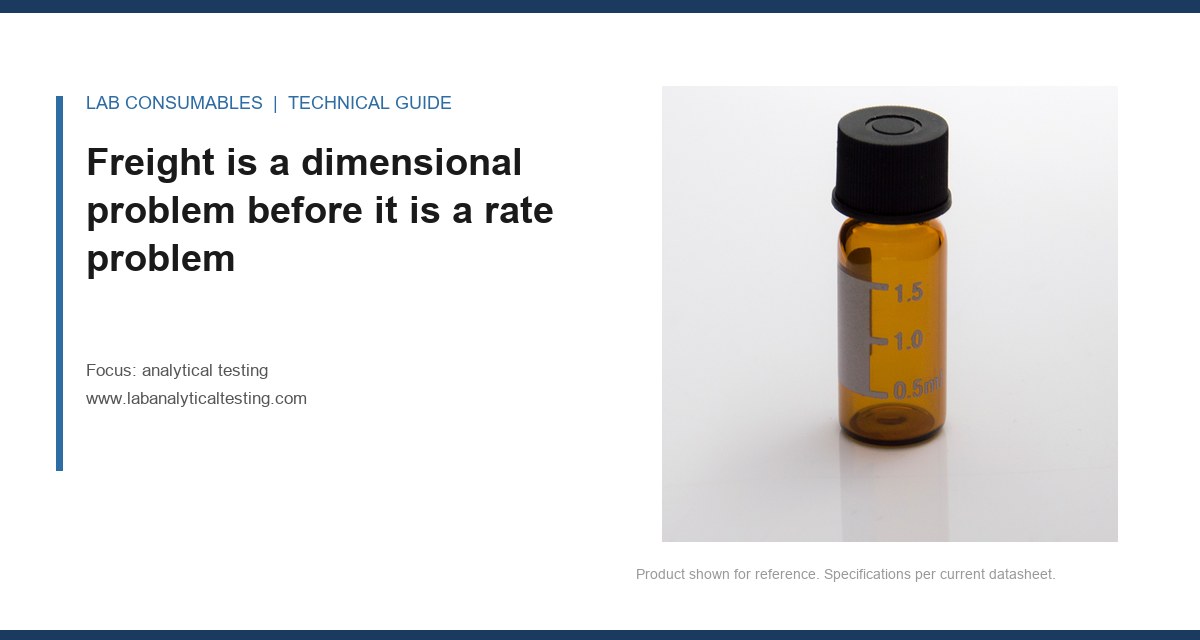
The quote was $42.80 per 100 vials, landed at $0.428 each, and the buyer had already signed a three-year agreement on that basis. Eight months later the actual cost per injected sample on that line was $0.61. Nothing about the unit price had changed. What changed was that 11% of lots failed the internal crimp-dimension check, two shipments sat 19 days in a customs-bonded warehouse in July, and 3% of vials arrived with cracked necks that only showed up after capping on an automated line running 400 samples a day. The gap between $0.428 and $0.61 is the whole subject of this article. If you are running an analytical testing landed cost calculation on unit price alone, you are pricing a product that never arrives in the condition you assumed.
I have run procurement for a consumables operation that shipped glass, polymer, and metal into regulated labs for 15 years. I have been on both sides of the invoice: the one that quotes the ex-works price and the one that eats the rework when a lot of septa bleeds phthalates into a blank. Unit price is the smallest honest number in the whole calculation. The rest of this is how I build the real one, with the freight, duty, inspection, storage, and failure terms that turn a per-piece quote into a cost per usable unit.
Analytical consumables are mostly air. A case of 2 mL chromatography vials at 12 x 32 mm weighs about 90 g of glass and cardboard and occupies roughly 0.006 m³. That means most of your freight bill is charged on volumetric weight, not actual weight. A 40 ft container of vial cases cubes out long before it weighs out. Carriers price on the greater of actual and dimensional weight, and for glass consumables the dimensional number usually wins by a factor of three to five.
The practical consequence: freight per usable unit is dominated by packing density, not by distance. I have seen two suppliers quote the same $0.40 vial and land it at $0.47 and $0.52 respectively because one packed 100 vials per tray in a 10-tray case with nested dividers and the other packed 100 per bag in a loose carton that had to be repacked at the 3PL. The second supplier’s carton also arrived with more breakage, which is a failure cost wearing a freight costume.
What to actually put in the freight term
- Dimensional weight conversion. Get the carton dimensions and the carrier divisor in writing (DHL and FedEx use 5000 cm³/kg for international; UPS uses 5000 for most air services). Multiply out the volumetric weight per case and divide by the unit count.
- Incoterms. FOB versus CIF versus DDP changes who owns the risk in transit. DDP looks clean on a spreadsheet and hides the fact that the supplier chose the cheapest forwarder. I price FOB and buy my own freight so I know what I am paying for insurance and handling.
- Dangerous goods surcharge. Solvent pre-cleaned vials, anything with residual solvent, and some reference materials carry a DG classification. That adds a flat per-shipment fee plus a per-kg rate that can double the air freight on a small lot.
- Temperature control. Reference standards and some biological consumables need 2 to 8 °C. A reefer container or dry-ice air shipment adds 40 to 90% to the freight line and a data logger you have to read on arrival.
Duty is a classification decision, and the classification is usually wrong
Most buyers assume duty is a fixed percentage the broker applies. It is not. It is a function of the HS code, the country of origin, and the declared value, and the HS code for a “laboratory glass vial” is not the same as for a “sample container” or a “pharmaceutical packaging component.” Under the U.S. Harmonized Tariff Schedule, borosilicate glass vials typically land under 7010.90 (glass containers for packing goods), while plastic caps and septa split off into 3923.50 and silicone septa into 3926.90. The duty rates differ, and the origin rules under a free trade agreement can zero out one line and leave the other at 3 to 6%.
The mistake I see most often is a single line item on the commercial invoice for “vials with caps and septa, assembled.” That forces the broker to classify the whole thing under one code, usually the highest applicable rate, and it also makes the origin declaration ambiguous. Split the invoice by component. It takes the supplier 20 minutes and saves you real money on every shipment.
The duty term in the landed cost formula
Duty is charged on the customs value, which is the transaction value (the price actually paid) plus the cost of packing and, depending on the jurisdiction, some freight and insurance. That means the freight line feeds the duty line. A heavy, badly packed shipment pays duty on its own freight. Add it explicitly:
Duty per unit = (invoice unit price + allocated packing cost + dutiable freight share) x duty rate
For a $0.40 vial at a 4% rate with $0.02 of dutiable freight, that is $0.0168 per unit. Small, but it compounds across a million units a year, and it is the line most spreadsheets omit entirely.
Inspection is where the quote stops being a quote
Every incoming lot of analytical consumables needs a receiving inspection, and the cost of that inspection belongs in the landed cost. It is not free just because your QC analyst was already on shift. Time spent counting, measuring, and running a suitability blank is time not spent on billable or production samples.
What I inspect and how long it takes for a typical lot of 5,000 vials:
- Dimensional check. Sample 30 vials per lot with calipers on critical dimensions (crimp neck OD, height, ID). Allow 15 minutes. Reference the applicable dimensional tolerances rather than eyeballing; a 12 x 32 mm vial with a neck OD outside the crimp spec will fail on the capper regardless of how good the glass is.
- Visual defect AQL. Use ANSI/ASQ Z1.4 at general inspection level II, AQL 1.0 for major defects (cracks, chips, foreign matter). For a 5,000-piece lot that is a sample of 200, and it takes 25 minutes.
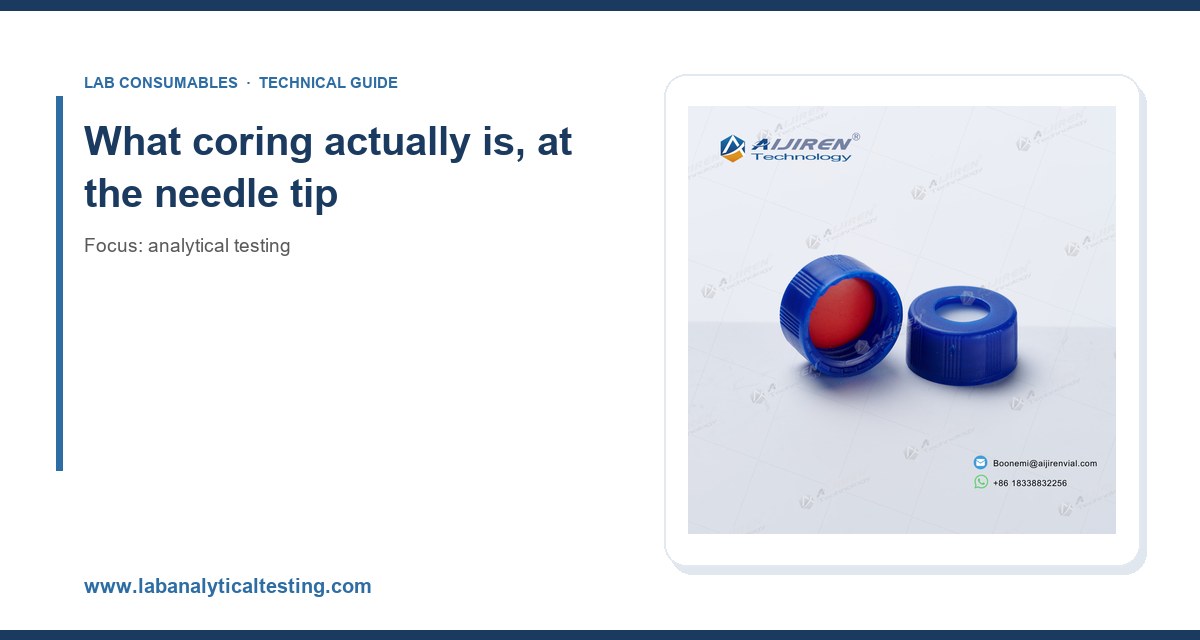
- Functional suitability. Cap 20 vials on the actual crimper at production torque, run a system suitability injection, and check for septa coring and injection-to-injection RSD. Allow 60 minutes including the HPLC run. This is the only check that catches a septa lot that is dimensionally perfect and chemically wrong.
- Documentation review. Certificate of analysis against the specification, plus the incoming CoA’s test methods. Allow 10 minutes.
That is roughly 110 minutes of analyst time per lot. At a fully loaded rate of $85/hour, that is $156 per lot, or $0.031 per vial on a 5,000-piece lot. If you receive 40 lots a year, you are spending $6,240 on inspection that never appears in the purchase price. On a smaller lot of 1,000 vials, the same inspection is $0.156 per unit, which is why lot size matters as much as unit price in the landed cost calculation.
Storage is a clock, not a shelf
Consumables that sit in a warehouse accrue cost in three ways: the cost of the space, the cost of the capital tied up in inventory, and the cost of the shelf life burning down. The third one is the one that bites.
Most polymer consumables have a finite useful life. Septa and septa-lined caps have a shelf life typically stated as 2 to 3 years from manufacture, and it is shorter once the packaging is opened. A lot that arrives with 18 months of shelf life remaining and then sits for 9 months in your stockroom has 9 months of usable life left, and if your consumption rate is slower than your receiving rate, you will scrap product you paid full price for. I have written off a full pallet of pre-assembled caps because the receiving date was not tracked against the manufacture date and the septa had hardened past the point where the needle punctured cleanly.
Storage cost per unit is straightforward arithmetic once you know the numbers:
- Space. A pallet position in a temperature-controlled warehouse runs $18 to $35 per month depending on market. Divide by the units on the pallet.
- Capital. Your cost of capital times the average inventory value. At 8%, a $50,000 average stock position costs $4,000 a year.
- Shelf-life decay. For each lot, compute (months in storage) / (total shelf life). If that ratio exceeds 25%, flag it. The decay is not a cash cost until you scrap, but it is a real reduction in usable yield, and it belongs in the cost per usable unit.
I track manufacture date on every incoming lot and apply a first-expiry-first-out rule, not FIFO. It is a five-minute change to the receiving process and it has saved more product than any negotiation I have run.
Failure cost is the number that decides the supplier
This is the bucket that separates a $0.43 vial from a $0.61 vial. Failure cost is what you spend when a consumable does not perform, and it has three components: the cost of the failed run, the cost of the investigation, and the cost of the corrective action.
Take a single failed HPLC sequence. A 96-injection run on a modern system at 25 minutes per injection is 40 hours of instrument time. If the failure is traced to septa coring (particles from the septum lodged in the needle or the column inlet), you lose the run, you may lose the column, and you spend a day on the investigation. A conservative estimate for one such event:
- Instrument time lost: 40 hours at $30/hour opportunity cost = $1,200
- Column replacement: $600 for a typical 150 x 4.6 mm, 5 µm C18
- Investigation labor: 8 hours at $85/hour = $680
- Repeat run consumables (mobile phase, standards): $150
That is $2,630 per failure event. If a septa lot causes one such event per 20,000 injections, and you run 200,000 injections a year, that is 10 events, or $26,300 a year. Spread across the 200,000 injections, it is $0.13 per injection. That single number is larger than the difference between the cheapest and the most expensive septa on the market. This is why I do not buy septa on unit price. The failure cost dominates.
Two field cases that only make sense in this cost model
Case 1: the crimp that looked fine. A production lab running a validated assay on a 12 x 32 mm vial started seeing injection-to-injection RSD climb from 0.4% to 1.8% over three weeks, with no change to the method. The measurement that identified it was a neck OD check on 30 vials from the current lot: the mean was within nominal, but the standard deviation had tripled, and 4 of 30 were outside the crimp spec. The capper was sealing some vials and leaving micro-gaps on others, and the micro-gaps were evaporating the sample. The fix was a lot-specific incoming neck OD check with a tighter internal limit than the supplier’s published tolerance, plus a switch to a supplier whose CoA reported the actual measured distribution rather than a pass/fail. The unit price went up 6%. The RSD came back to 0.4%. The landed cost per usable injection went down because the failure cost went to near zero.
Case 2: the septa that bled. A lab running trace phthalate analysis on Thermo Fisher sample handling hardware kept seeing a siloxane peak at a retention time that did not match any analyte. The blank injection was clean when the vial was capped with a PTFE-faced silicone septa from the original supplier and dirty when capped with a cheaper lot from a second source. The measurement that identified it was a solvent blank run with each septa lot, five injections each, looking at the peak area at the suspect retention time. The cheap lot showed a peak 12 times the original. The fix was a septa qualification protocol: every incoming lot runs a blank injection series and must show no peak above the method’s limit of detection at the suspect retention times. That protocol costs 30 minutes per lot and it caught two bad lots in the first year.
The worked example: $0.428 to $0.61
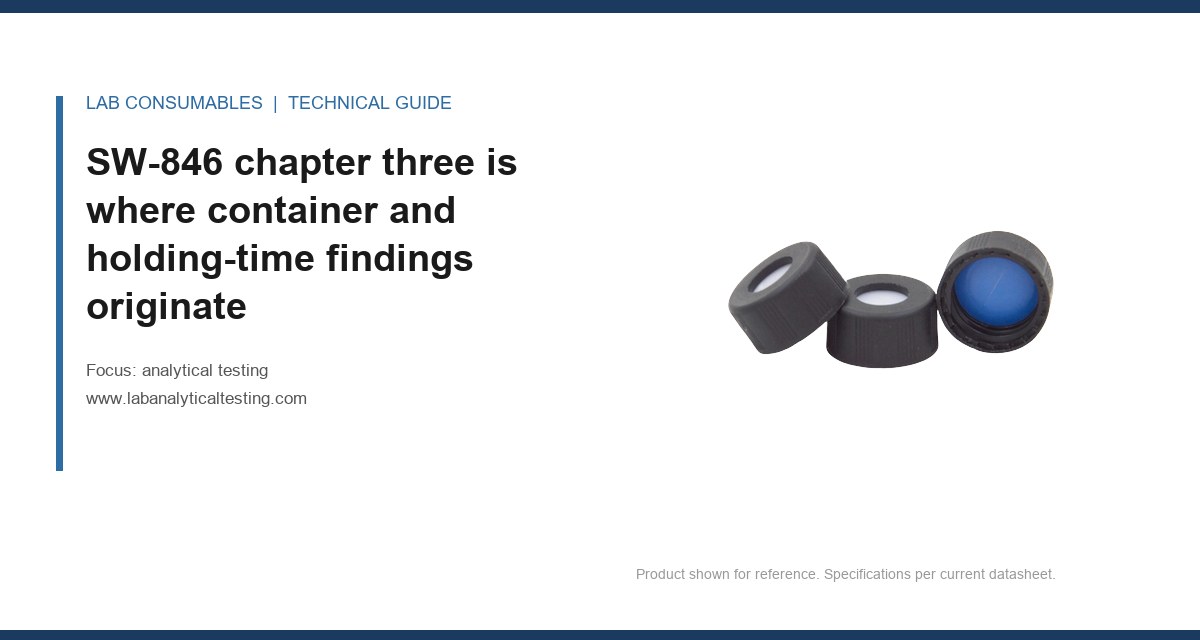
Here is the full calculation on the lot that started this article. 100,000 vials, 12 x 32 mm, with pre-assembled caps and PTFE/silicone septa, sourced FOB from an overseas supplier at $42.80 per 100, or $0.428 each.
| Cost bucket | Basis | Per unit |
|---|---|---|
| Unit price (FOB) | Invoice | $0.4280 |
| Freight (dimensional weight, air) | $4,200 / 100,000 | $0.0420 |
| Insurance | 0.5% of invoice value | $0.0021 |
| Duty | 4% on (invoice + dutiable freight) | $0.0188 |
| Customs brokerage and clearance | $650 / 100,000 | $0.0065 |
| Incoming inspection | 110 min x $85 / 100,000 | $0.0156 |
| Storage (3 months, temp-controlled) | $900 / 100,000 | $0.0090 |
| Breakage and repack (3% of lot) | 3% x $0.428 | $0.0128 |
| Failure cost (septa coring events) | $2,630 x 2 events / 100,000 | $0.0526 |
| Total landed cost | $0.5874 | |
| Usable yield | 97% after breakage and rejects | |
| Cost per usable unit | $0.5874 / 0.97 | $0.6056 |
The cost per usable unit is $0.606, not $0.428. The unit price was 71% of the true cost. The failure cost alone added $0.053, and the yield adjustment added another $0.018. If I had run the same calculation on the higher-priced supplier whose septa did not core, the unit price would have been $0.454 and the failure cost would have been near zero, landing at roughly $0.55 per usable unit. The cheaper quote was the more expensive product.
Decision checklist for the landed cost calculation
- Get carton dimensions and unit count per case in writing. Compute dimensional weight yourself. Do not accept “freight included.”
- Split the commercial invoice by component (vial, cap, septa) so the broker can classify each line correctly.
- State the Incoterm and the origin declaration on every purchase order. FOB with your own forwarder is the default I recommend.
- Build an inspection cost per lot from actual analyst time, not a guess. Include the functional suitability run, not just the visual check.
- Track manufacture date on receipt and apply first-expiry-first-out. Flag any lot with less than 75% of shelf life remaining.
- Qualify every new lot functionally against the method it will be used in. A blank injection series is the cheapest failure-cost insurance you can buy.
- Compute cost per usable unit, not cost per unit. The yield adjustment is where the breakage and rejects live.
- Re-run the calculation annually with actual failure event counts, not estimates. The failure term is the one that moves.
Where the numbers come from and how to keep them honest
The failure cost term is the hardest to populate because it requires you to count events, and most labs do not. I recommend a simple log: every time a run fails and the root cause traces to a consumable, record the instrument time, the replacement parts, the investigation hours, and the lot number. After six months you will have a real failure rate per lot, and that number goes straight into the landed cost calculation. The U.S. EPA SW-846 test methods and the Restek technical resources both publish consumable suitability guidance that gives you a defensible basis for the functional check, and the major instrument vendors publish comparable guidance for their own hardware. Use those as the specification you inspect against, not the supplier’s marketing sheet.
One more thing on the duty and classification side: the HS code you use should match the code your supplier declares on the export side. A mismatch is a customs hold, and a customs hold is a storage cost and a schedule risk at the same time. I have had a shipment sit for 11 days because the supplier declared the caps under one code and the broker filed under another. The demurrage and the expedited freight to recover the schedule added $0.019 per unit to that lot. That is a real number that never appears on a quote.
If you are sourcing across multiple categories, the same logic applies to chromatography products generally and to the HPLC vial supply specifically: the component that touches the sample is the one whose failure cost dominates, and it is the one worth paying more for. The Agilent chromatography consumables catalog is a useful reference for how a manufacturer documents dimensional and chemical specs, and it is a good benchmark for what you should demand from any supplier’s CoA. For the full scope of what we test and source, the analytical testing resource library is the starting point.
The decision rule is this: never approve a consumable purchase on unit price. Build the landed cost with freight, duty, inspection, storage, and failure terms, divide by usable yield, and compare cost per usable unit. If the failure term is unknown, run a lot qualification before you commit, because an unqualified lot is a cost you have not measured yet. The supplier who wins on cost per usable unit is almost never the one who wins on the quote.
References & further reading
Related resources from our lab consumables network:
- Analytical Testing at labanalyticaltesting.com
- Chromatography Vial at chromvials.com
- Hplc Vial at hplcvialfactory.com
- Chromatography Products at chromatographyforsale.com
External references and standards: